
Mission Statement
BOCK WINE AND SPIRITS GOALS
To care about the clientele of our customers and their pure satisfaction from the wines & spirits we represent.
To offer the most complete line of terroir-driven wines & spirits in the world. To strive for products that are harmonious, balanced, and value oriented.
To search out wine producers that are, first and foremost, wine growers, and if not so lucky as to own their own vines, to obtain producers who have strong and collaborative relationships with their growers.
To search out distillers who have a keen knowledge of their craft and who, while respecting tradition, are evolving at the same time their art of producing essential spirits.
To represent our wines and spirits in a professional and courteous manner.
To constantly grow and enhance our knowledge of the wine and spirits products that we represent and expand our relationships with our suppliers to better serve our customers.
To represent only producers with integrity and high standards. These beliefs and high standards must be carried through to the end product, giving us the best wines and spirits to present to our clients.
To be economically viable, honest, and productive.
The bottom line: we are customer-driven. And we care about your bottom line.

Lou Bock—President
BOCK WINE & SPIRITS
✷
BOCK WINE & SPIRITS ✷
A BRIEF HISTORY OF WINEHAVEN
Home of Bock Wine and Spirits
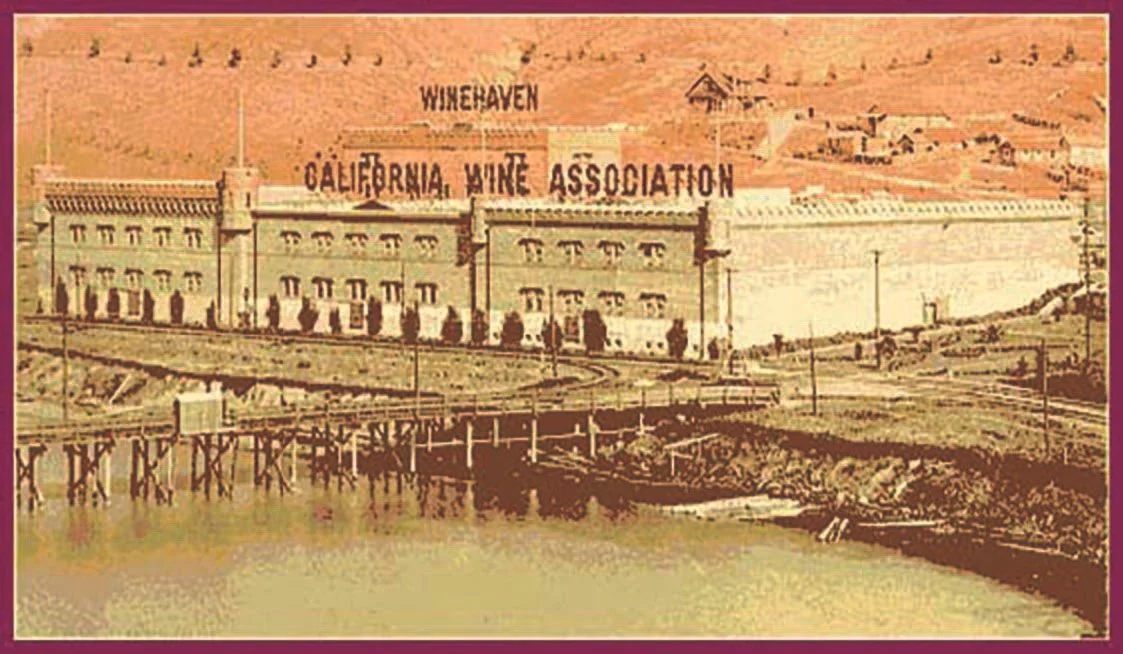
PHOTO: View of Building 1 (storage cellar), facing north -- Winehaven, Point Molate, Richmond, California, USA
Winehaven was a winery and town in Richmond, California, that held the title of “World’s Largest Winery” for twelve years (1907–1919). It later became a fuel depot for the United States Navy.
After the 1906 San Francisco earthquake left the city in ruins, the California Wine Association moved to Point Molate, a promontory on the east shore of San Pablo Bay, and began construction of Winehaven. At the peak of the season, as many as 400 workers lived here, as all of the California Wine Association’s shipments to foreign, coastal and New York markets sailed from the Winehaven dock—shipment capacity was 500,000 gallons (1,892,705 liters) a month, and 40 ships sailed annually for New York alone. The winery was shut down by Prohibition in 1919, and the company sold off its assets to avoid bankruptcy. Winehaven went mostly unused from about 1920 until the late 1930s.
A post office operated at Winehaven from 1910 to 1925.
The Navy bought the 412 acres (167 ha) site in 1941, moved into the winery buildings, and constructed 20 large concrete tanks on the hillsides above for a fuel depot. Thousands of drums of fuel were stored in huge buildings, pipelines were laid, a new pier was built and the old one was eventually removed. The old Winehaven Hotel was pressed into service for a period as barracks and mess hall, and the workers’ houses were renovated for the use of naval personnel. The Commanding Officer of the Naval Fuel Depot was assigned the largest house on the bluff overlooking the others, which previously had been the home of the winery superintendent.
Despite the switch from wine to fuel, the historic district remains virtually unaltered from its days as a winery. There are 35 buildings in the National Register historic district built between 1907 and 1919, the most notable being the castle-like Winehaven Building adorned with crenellated parapet and corner turrets. Also within the district is the Winemaster’s House (Building 60), which became the Commanding Officer’s residence, and the Village of Point Molate, a row of turn-of-the-century cottages used to house Winehaven and military families. The Navy continued to operate the fuel depot during the Korean War and Vietnam War until it was decommissioned in 1995.